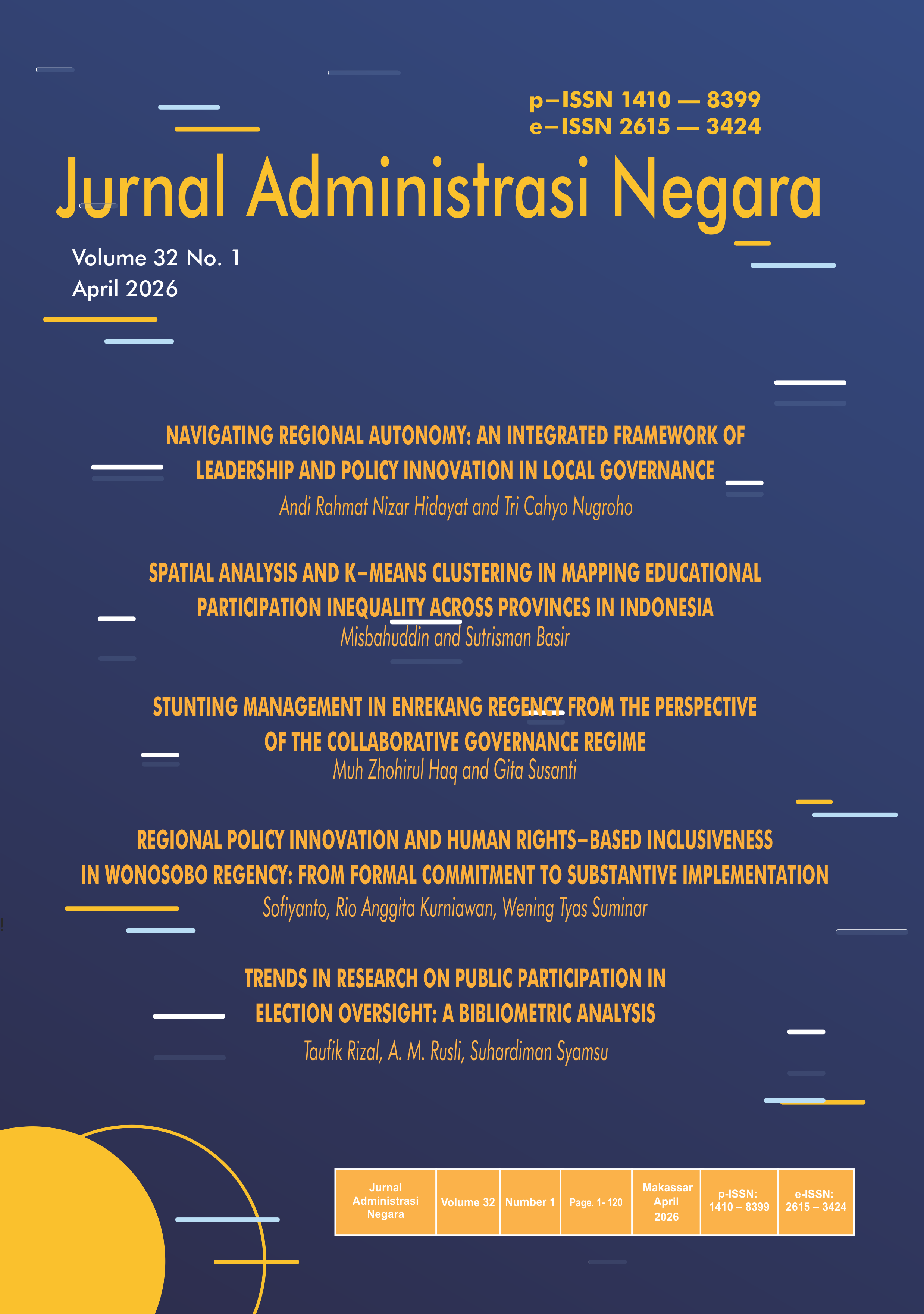
STUNTING MANAGEMENT IN ENREKANG REGENCY FROM THE PERSPECTIVE OF THE COLLABORATIVE GOVERNANCE REGIME
DOI:
https://doi.org/10.33509/jan.v32i1.3859Keywords:
Collaborative Governance, Stunting, EnrekangAbstract
Stunting is a chronic nutritional problem with widespread impacts on the quality of human resources and sustainable development. One of the regions with the highest stunting rates is Enrekang Regency, South Sulawesi Province. Enrekang Regency has consistently recorded one of the highest stunting prevalence rates in South Sulawesi from year to year and has yet to achieve its prevalence reduction target. This study examines the implementation of the Collaborative Governance Regime (CGR) in managing stunting in Enrekang Regency. It aims to analyze the dynamics of multi-actor collaboration as well as the supporting and inhibiting factors affecting program effectiveness. This qualitative case study collected data through interviews and observations, which were then analyzed interactively and validated using triangulation techniques. The results indicate that inter-agency collaboration in Enrekang has been established through the three main dimensions of CGR: principled engagement, shared motivation, and capacity for joint action, which are manifested in integrated programs such as the Bapak/Bunda Asuh Anak Stunting (Stunting Children Foster Parents) initiative and cross-sectoral Convergence Actions. Since its inception, this collaboration has successfully reduced stunting rates from 28.50% (2019), 23.30% (2020), 21.50% (2021), 19.45% (2022), to 19.04% (2023). These results indicate that the dynamics of collaboration involving specific and sensitive interventions can increase public awareness in stunting management. However, obstacles were found in the form of budget constraints, government dominance in deliberative processes, and data collection challenges. Adaptation was carried out by focusing interventions on priority locus areas, optimizing the role of posyandu (integrated health post) cadres, and strengthening institutional coordination. It is concluded that strengthening fiscal capacity, involving non-governmental sectors, and improving the data collection system are key to the sustainability of collaborative stunting reduction at the regional level.
Downloads
References
Abri, N. (2022). Identification of Socio-Demographic Factors with the Incidence of Stunting in Elementary School Children in Rural Enrekang. Journal of Health and Nutrition Research, 1(2), 88–94. https://doi.org/10.56303/jhnresearch.v1i1.20
Amraini, N., Zainal, S., & Darmawan, S. (2024). PENGARUH EDUKASI STUNTING MENGGUNAKAN METODE AUDIOVISUAL TERHADAP PENGETAHUAN IBU DI DESA SANGLEPONGAN KECAMATAN CURIO KABUPATEN ENREKANG. Jurnal Ilmiah Mahasiswa & Penelitian Keperawatan, 4, 238–243. https://jurnal.stikesnh.ac.id/index.php/jimpk/article/view/1466/1020
Ansell, C., & Doberstein, C. (2020). Understanding inclusion in collaborative governance : a mixed methods approach. 39(4), 570–591.
Ansell, C., & Gash, A. (2008). Collaborative governance in theory and practice. Journal of Public Administration Research and Theory, 18(4), 543–571. https://doi.org/10.1093/jopart/mum032
Aziza Bila, B. S. (2019). STRATEGI COLLABORATIVE GOVERNANCE DALAM PEMERINTAHAN. Jurnal Transformasi Administrasi, 9, 196–210.
Barlow, R. (2022). Deliberation Without Democracy in Multi ‑ stakeholder Initiatives : A Pragmatic Way Forward. Journal of Business Ethics, 181(3), 543–561. https://doi.org/10.1007/s10551-021-04987-x
Casanovas, C., Lutter, C. K., Mangasaryan, N., Mwadime, R., Hajeebhoy, N., Aguilar, A. M., Kopp, C., Rico, L., Ibiett, G., Andia, D., & Onyango, A. W. (2013). Multi-sectoral interventions for healthy growth. Maternal & Child Nutrition, 9, 46–57. https://doi.org/10.1111/mcn.12082
Douglas, S., & Berthod, O. (2020). Pathways to collaborative performance : examining the di ff erent combinations of conditions under which collaborations are successful. Policy and Society, 39(4), 638–658.
Dwi, A., Setyawan, R., Setyawan, T., & Sucipto, E. (2025). The Impact of Multisectoral Nutrition Interventions on Stunting Rates Among Children Under Five Years Old : A Systematic Review General Practitioner , Toroh 2 Public Health Center , Grobogan Head of Administration , Toroh 2 Public Health Center , Grobogan. The International Journal of Medical Science and Health Research, 10(06), 54–95. https://internationalmedicaljournal.org/index.php/ijmhsr/article/view/311?utm_source=chatgpt.com
Emerson, K., & Nabatchi, T. (2015). Evaluating the Productivity of Collaborative Governance Regimes : A Evaluating the Productivity of Collaborative Governance Regimes : A Performance Matrix. Public Performance & Management Review ISSN:, 38(October), 717–747. https://doi.org/10.1080/15309576.2015.1031016
Emerson, K., Nabatchi, T., & Balogh, S. (2012). An Integrative Framework for Collaborative Governance. Journal of Public Administration Research and Theory, 22(June 2009), 1–29. https://doi.org/10.1093/jopart/mur011
Frerichs, L., Kim, M., Dave, G., Cheney, A., Lich, K. H., Jones, J., Young, T. L., Crystal, W., Varma, D. S., Schaal, J., Black, A., Cottler, L. B., Brown, A., Burke, J. G., Hill, C., & Hill, C. (2018). Stakeholder Perspectives on Creating and Maintaining Trust in Community–Academic Research Partnerships. Health and Human Service, 44(1), 182–191. https://doi.org/10.1177/1090198116648291.Stakeholder
Grootjans, S. J. M., Stijnen, M. M. N., Kroese, M. E. A. L., Ruwaard, D., & Jansen, M. W. J. (2022). Collaborative governance at the start of an integrated community approach : a case study. BMC Public Health, 1–11. https://doi.org/10.1186/s12889-022-13354-y
Hamilton, A. B., Finley, E. P., Angeles, L., Sciences, B., Angeles, L., Antonio, S., Antonio, H. S., & Antonio, S. (2020). Qualitative Methods in Implementation Research: An Introduction. Health and Human Service, 11, 1–18. https://doi.org/10.1016/j.psychres.2019.112516.Qualitative
Hoddinott, J., Alderman, H., Behrman, J. R., Haddad, L., & Horton, S. (2020). The economic rationale for investing in stunting reduction. Maternal & Child Nutrition, 2020(2013), 69–82. https://doi.org/10.1111/mcn.12080
Hossain, M., Choudhury, N., Adib, K., Abdullah, B., Mondal, P., Jackson, A. A., Walson, J., & Ahmed, T. (2017). Evidence-based approaches to childhood stunting in low and middle income countries : a systematic review. BMJ Journal, 903–909. https://doi.org/10.1136/archdischild-2016-311050
Jailani, M. S. (2023). Teknik Pengumpulan Data Dan Instrumen Penelitian Ilmiah Pendidikan Pada Pendekatan Kualitatif dan Kuantitatif. IHSAN: Jurnal Pendidikan Islam, 1, 1–9.
Komang, N., Apriastini, T., Putu, N., Adnyani, T., Selvyani, P. O., Hendra, K., Kedokteran, P., & Ganesha, U. P. (2024). STUNTING : FAKTOR RISIKO , DIAGNOSIS , TATALAKSANA , DAN. Ganesha Medicina Journal, 4(1), 17–23.
Kresnawati, W., Ambarika, R., & Saifulah, D. (2022). Pengetahuan dan Sikap Ibu Balita Sadar Gizi terhadap kejadian Stunting. Journal Of Health Science Community, 3(1), 26–33. https://thejhsc.org/index.php/jhsc
Malik, S., Roosli, R., & Yusof, N. (2022). Institutional stakeholder collaborations ( ISCs ): a conceptual framework for housing research framework for housing research. Journal of Housing and the Built Environment, April. https://doi.org/10.1007/s10901-021-09834-z
Marhaeni, D., Herawati, D., & Sunjaya, D. K. (2022). Implementation Outcomes of National Convergence Action Policy to Accelerate Stunting Prevention and Reduction at the Local Level in Indonesia : A Qualitative Study. International Journal of Enviromental Research and Public Health, 19.
Maysarah, N., & Wahyudi, R. (2023). COLLABORATIVE GOVERNANCE IN DRUG PREVENTION BETWEEN THE NATIONAL NARCOTICS AGENCY OF PEKANBARU CITY AND THE PEKANBARU CLASS II SPECIAL CHILDREN ’ S DEVELOPMENT INSTITUTION. Jurnal El-Riyasah, 14, 134–147.
Mcgovern, M. E., Krishna, A., & Aguayo, V. M. (2017). Social and Economic Determinants A review of the evidence linking child stunting to economic outcomes. International Journal of Epidemiology, March, 1171–1191. https://doi.org/10.1093/ije/dyx017
Nasrulhaq. (2020). Nilai Dasar Collaborative Governance Dalam Studi Kebijakan Publik. Jurnal Administrasi Publik, 6. https://internationalmedicaljournal.org/index.php/ijmhsr/article/view/311?utm_source=chatgpt.com
Ni Ketut Aryastami, I. T. (2017). Kajian Kebijakan dan Penanggulangan Masalah Gizi Stunting di Indonesia. Buletin Penelitian Kesehatan, 45, 233–240.
Noronha, J. A., Ladd, E., & George, A. (2021). Qualitative Methods in Health Care Research. International Journal of Preventive Medicine, 1–7. https://doi.org/10.4103/ijpvm.IJPVM
Nurahadiyatika, F., Atmaka, D. R., & Imani, A. I. (2022). Peningkatan Ketahanan Pangan Dan Pengentasan Status Kemiskinan Dalam Konvergensi Penurunan Angka Stunting. Media Gizi Indonesia, 17(1SP), 215–220. https://doi.org/10.20473/mgi.v17i1sp.215-220
Park, A. Y. S., Krause, R. M., & Hawkins, C. V. (2021). Institutional Mechanisms for Local Sustainability Collaboration : Assessing the Duality of Formal and Informal Mechanisms in Promoting Collaborative Processes. Journal of Public Administration Research and Theory, 434–450. https://doi.org/10.1093/jopart/muaa036
Suparyanto dan Rosad. (2020). Gambaran Pengetahuan Gizi dan Pola Asuh Ibu terhadap Kejadian Stunting. Suparyanto Dan Rosad, 5(3), 248–253.
United Nations Children’s Fund (UNICEF), World Health Organization, I. B. for R. and D. W. B. (2021). Levels and Trends in Child Malnutrition: UNICEF/WHO/World Bank Joint Child Malnutrition Estimates: Key Findings of the 2021 Edition. https://data.unicef.org/nutrition
Vangen, S., Hayes, J. P., & Cornforth, C. (2014). Governing Cross-Sector , Inter- Organizational Collaborations. Public Management Review, December 2014, 37–41. https://doi.org/10.1080/14719037.2014.903658
Vermeulen, V., & Hémond, Y. (2025). Interdisciplinary collaboration in VUCA contexts : a conceptual review for environmental upheavals management. Environmental Systems Research, 6.
Abri, N. (2022). Identification of socio-demographic factors with the incidence of stunting in elementary school children in rural Enrekang. Journal of Health and Nutrition Research, 1(2), 88–94. https://doi.org/10.56303/jhnresearch.v1i1.20
Amraini, N., Zainal, S., & Darmawan, S. (2024). Pengaruh edukasi stunting menggunakan metode audiovisual terhadap pengetahuan ibu di Desa Sanglepongan Kecamatan Curio Kabupaten Enrekang. Jurnal Ilmiah Mahasiswa & Penelitian Keperawatan, 4, 238–243. https://jurnal.stikesnh.ac.id/index.php/jimpk/article/view/1466/1020
Ansell, C., & Doberstein, C. (2020). Understanding inclusion in collaborative governance: A mixed methods approach. Journal of Public Administration Research and Theory, 30(4), 570–591.
Ansell, C., & Gash, A. (2008). Collaborative governance in theory and practice. Journal of Public Administration Research and Theory, 18, 543–571. https://doi.org/10.1093/jopart/mum032
Aziza Bila, B. S. (2019). Strategi collaborative governance dalam pemerintahan. Jurnal Transformasi Administrasi, 9, 196–210.
Barlow, R. (2022). Deliberation without democracy in multi-stakeholder initiatives: A pragmatic way forward. Journal of Business Ethics, 181(3), 543–561. https://doi.org/10.1007/s10551-021-04987-x
Casanovas, C., Lutter, C. K., Mangasaryan, N., Mwadime, R., Hajeebhoy, N., Aguilar, A. M., Kopp, C., Rico, L., Ibiett, G., Andia, D., & Onyango, A. W. (2013). Multi-sectoral interventions for healthy growth. Maternal & Child Nutrition, 9, 46–57. https://doi.org/10.1111/mcn.12082
Douglas, S., & Berthod, O. (2020). Pathways to collaborative performance: Examining the different combinations of conditions under which collaborations are successful. Policy and Society, 39(4), 638–658.
Dwi, A., Setyawan, R., Setyawan, T., & Sucipto, E. (2025). The impact of multisectoral nutrition interventions on stunting rates among children under five years old: A systematic review. International Journal of Medical Science and Health Research, 10(6), 54–95. https://internationalmedicaljournal.org/index.php/ijmhsr/article/view/311
Emerson, K., & Nabatchi, T. (2015). Evaluating the productivity of collaborative governance regimes: A performance matrix. Public Performance & Management Review, 38, 717–747. https://doi.org/10.1080/15309576.2015.1031016
Emerson, K., Nabatchi, T., & Balogh, S. (2012). An integrative framework for collaborative governance. Journal of Public Administration Research and Theory, 22, 1–29. https://doi.org/10.1093/jopart/mur011
Frerichs, L., Kim, M., Dave, G., Cheney, A., Lich, K. H., Jones, J., Young, T. L., Varma, D. S., Schaal, J., Black, A., Cottler, L. B., Brown, A., Burke, J. G., Hill, C., & Hill, C. (2018). Stakeholder perspectives on creating and maintaining trust in community–academic research partnerships. Health & Human Services, 44(1), 182–191. https://doi.org/10.1177/1090198116648291
Grootjans, S. J. M., Stijnen, M. M. N., Kroese, M. E. A. L., Ruwaard, D., & Jansen, M. W. J. (2022). Collaborative governance at the start of an integrated community approach: A case study. BMC Public Health, 22, 1–11. https://doi.org/10.1186/s12889-022-13354-y
Hamilton, A. B., Finley, E. P., Angeles, L., & others. (2020). Qualitative methods in implementation research: An introduction. Health Services Research, 11, 1–18. https://doi.org/10.1016/j.psychres.2019.112516
Hoddinott, J., Alderman, H., Behrman, J. R., Haddad, L., & Horton, S. (2020). The economic rationale for investing in stunting reduction. Maternal & Child Nutrition, 2020, 69–82. https://doi.org/10.1111/mcn.12080
Hossain, M., Choudhury, N., Adib, K., Abdullah, B., Mondal, P., Jackson, A. A., Walson, J., & Ahmed, T. (2017). Evidence-based approaches to childhood stunting in low- and middle-income countries: A systematic review. Archives of Disease in Childhood, 102, 903–909. https://doi.org/10.1136/archdischild-2016-311050
Jailani, M. S. (2023). Teknik pengumpulan data dan instrumen penelitian ilmiah pendidikan pada pendekatan kualitatif dan kuantitatif. IHSAN: Jurnal Pendidikan Islam, 1, 1–9.
Komang, N., Apriastini, T., Adnyani, T. P., Selvyani, P. O., & others. (2024). Stunting: Faktor risiko, diagnosis, tatalaksana, dan pencegahan. Ganesha Medicina Journal, 4(1), 17–23.
Kresnawati, W., Ambarika, R., & Saifulah, D. (2022). Pengetahuan dan sikap ibu balita sadar gizi terhadap kejadian stunting. Journal of Health Science Community, 3(1), 26–33.
Malik, S., Roosli, R., & Yusof, N. (2022). Institutional stakeholder collaborations (ISCs): A conceptual framework for housing research. Journal of Housing and the Built Environment. https://doi.org/10.1007/s10901-021-09834-z
Marhaeni, D., Herawati, D., & Sunjaya, D. K. (2022). Implementation outcomes of national convergence action policy to accelerate stunting prevention and reduction at the local level in Indonesia: A qualitative study. International Journal of Environmental Research and Public Health, 19.
Maysarah, N., & Wahyudi, R. (2023). Collaborative governance in drug prevention between the National Narcotics Agency and juvenile institutions. Jurnal El-Riyasah, 14, 134–147.
McGovern, M. E., Krishna, A., & Aguayo, V. M. (2017). Social and economic determinants of child stunting. International Journal of Epidemiology, 46, 1171–1191. https://doi.org/10.1093/ije/dyx017
Nasrulhaq. (2020). Nilai dasar collaborative governance dalam studi kebijakan publik. Jurnal Administrasi Publik, 6.
Ni Ketut Aryastami, & Tarigan, I. (2017). Kajian kebijakan dan penanggulangan masalah gizi stunting di Indonesia. Buletin Penelitian Kesehatan, 45, 233–240.
Noronha, J. A., Ladd, E., & George, A. (2021). Qualitative methods in health care research. International Journal of Preventive Medicine, 12, 1–7.
Nurahadiyatika, F., Atmaka, D. R., & Imani, A. I. (2022). Peningkatan ketahanan pangan dan pengentasan kemiskinan dalam konvergensi penurunan stunting. Media Gizi Indonesia, 17(1SP), 215–220. https://doi.org/10.20473/mgi.v17i1sp.215-220
Park, A. Y. S., Krause, R. M., & Hawkins, C. V. (2021). Institutional mechanisms for local sustainability collaboration. Journal of Public Administration Research and Theory, 31, 434–450. https://doi.org/10.1093/jopart/muaa036
Suparyanto dan Rosad. (2020). Gambaran pengetahuan gizi dan pola asuh ibu terhadap kejadian stunting. Suparyanto dan Rosad, 5(3), 248–253.
Vangen, S., Hayes, J. P., & Cornforth, C. (2014). Governing cross-sector, inter-organizational collaborations. Public Management Review.
Vermeulen, V., & Hémond, Y. (2025). Interdisciplinary collaboration in VUCA contexts: A conceptual review for environmental upheavals management. Environmental Systems Research, 6.
Downloads
Published
How to Cite
Issue
Section
License
Copyright (c) 2026 Politeknik STIA LAN Makassar

This work is licensed under a Creative Commons Attribution-NonCommercial-ShareAlike 4.0 International License.
Policy for Journals That Offer Open Access
Authors who publish with this journal agree to the following terms:
- Authors retain copyright and grant the journal right of first publication with the work simultaneously licensed under a Creative Commons Attribution-NonCommercial-ShareAlike 4.0 International License that allows others to share the work with an acknowledgement of the work's authorship and initial publication in this journal.
- Authors are able to enter into separate, additional contractual arrangements for the non-exclusive distribution of the journal's published version of the work (e.g., post it to an institutional repository or publish it in a book), with an acknowledgement of its initial publication in this journal.
- Authors are permitted and encouraged to post their work online (e.g., in institutional repositories or on their website) prior to and during the submission process, as it can lead to productive exchanges, as well as earlier and greater citation of published work (See The Effect of Open Access).